
Thanks for clicking over! Here are three samples from the stories in the Mermaid Song fairytale collection for your reading pleasure…

THE SEA KING’S DAUGHTER – A Celtic Little Mermaid Retelling
The surface of the North Sea rolled and ruffled quietly beneath the May wind. In the sky overhead, gulls caught the eddies, calling in high, lonely voices. The rocky shore of Eire rose on the horizon, a dark blur of land before the water stretched away for thousands of miles to the west.
Beneath the waters, the calm beauty of the day mattered little. Pale sunshine filtered down, and further down, to the very halls of the Sea King, where the matters of the world above meant very little. His palace rose from the sea bed, whorls of shell and pearl glowing with iridescence. Four fanciful towers, one for each of his daughters, were decked with banners of woven sea grass that waved in the gentle eddies
The open, curved halls were traversed by fishes and merfolk alike on their way to the throne room for the birthday celebrations of the king’s youngest daughter, Muireen.
This was not any birthday, however, but the coming of age Muireen had been waiting years for. Finally she was turning seventeen and would be allowed to rise to the surface for her first glimpse of the mortal world.
Six years earlier, her eldest sister Aila had been the first of them to break the surface of the bright water and see what wonders the world above held.
“Tell us, tell us,” her sisters had clamored when she returned, then listened, wide-eyed, to Aila’s descriptions of the wheeling birds, the bright sun, the taste of air in her lungs instead of water.
She had even glimpsed a mortal ship riding majestic over the waves, all unaware of the kingdom they traveled over. Although her bodyguard had not allowed her swim any closer, for fear of discovery, Aila had heard singing, and a strange buzzing instrument not known beneath the sea.
The next sister to rise, Dagmar, had shaken her head dismissively upon her return.
“It’s gray and cold,” she’d said. “Water spits in cold drops from the sky, and the bones of fish float, rotting, in the waves. There is no reason to visit the world above.”
“What of the mortals?” Muireen had asked.
“I saw no sign,” Dagmar said, flat disinterest in her voice.
When the second-youngest sister made her trip to the surface, she proclaimed it “quiet and a bit boring.”
Privately, Muireen vowed that she would swim toward shore. She would stay from dawn to dusk and do everything she could to catch a glimpse of the mortals who inhabited the world of air. Whether or not the guards that would accompany her would allow such a thing was a question she pushed away. Her determination was strong enough to succeed.
For years, Muireen and her sisters had scavenged the shipwrecks scattered on the ocean floor. But while her older siblings had lost interest, Muireen still was fascinated by the strange objects to be found in the detritus. She could not make heads nor tails of many of the items, but whether they were weapons or decorations or strange tools, they piqued her imagination.
“Why can we not visit the surface more than once a year?” she’d asked her father. “Surely we can learn things from the mortals above.”
“No,” the Sea King had said, his voice hard. “The only thing they may teach our kind is death and destruction. Our history is filled with tales of murder, the blood of our people staining the currents while they hunted us down without mercy. Once a year is danger enough.”
Only the weight of law and custom kept her father from forbidding all merfolk from ever rising to the surface.
Today, though, was her day. Muireen’s heart beat faster. Today, she would feel the mystery of the sun on her face, breathe the strangeness of air, hear the sounds of the birds.
And maybe, if luck was with her, she would set her eyes on a mortal.
***
Eiric Airgead set his carefully folded nets in his small boat, checked that it was not taking on water, then stepped in and pushed off from the stone jetty. The sky overhead cupped the pearly pre-dawn light, and the village’s small harbor was busy with fishermen heading out to make the day’s catch. Half the fleet was already gone, their boats patches of darkness over the pewter water.
The sea wind blew Eiric’s dark hair about his face, the breeze strong enough for him to raise sail. Quickly, his boat flew out, rocking up and down when he hit the rougher water outside the sheltering curve of the harbor. Behind him, whitewashed cottages glowed softly with the dawn over their shoulders. The stone-walled fields and lanes climbed up the hillside, and he could see a half dozen villagers striding up to tend the fields and flocks.
He’d never had the heart of a farmer, himself. The sea always called to him, the waves whispering his name. The village lived by the sea. And died by it, as well—as no doubt would be his own fate.
But while he lived, he’d ride his small boat over the waves, casting his nets beneath the surface to pull up silver shimmering wonders of fishes. He’d sing, and play the tin whistle tucked in his pocket to pass the time. Most of all, he’d know the freedom of the wind and water, the language of current and cloud.
Bright porpoises danced beside his boat, and seals watched him with their large, dark eyes. The huge Ainmhí Sheoil moved like a dark shadow below him, but he was wiser than to cast a line for the shark. His boat was too small, his arms too weak.
It took many men in a larger craft to be able to ride out the death run of such a massive fish. Once, one of the village’s boats was gone for nearly an entire moon. When they finally returned, they told a harrowing and heroic tale of being dragged far to the north by the basking shark, at last overcoming it, and then making the long journey home. That winter, the village ate well.
Though Eiric fished alone, he contributed enough to the village’s stores that he was considered a hard worker, and a good match for any of the lasses. Red-haired Biddy had made it plain she’d welcome him to come courting, but she had a hard edge that Eiric misliked. Perhaps he might instead woo Orla, who tended her flock of sheep, but she was a quiet girl. Too quiet, mayhap.
Eiric’s mother was gone, and his father as well, leaving no one to push him toward a marriage he was not certain he wanted. And so he fished, and played tunes up to the sky, and was content to live alone.
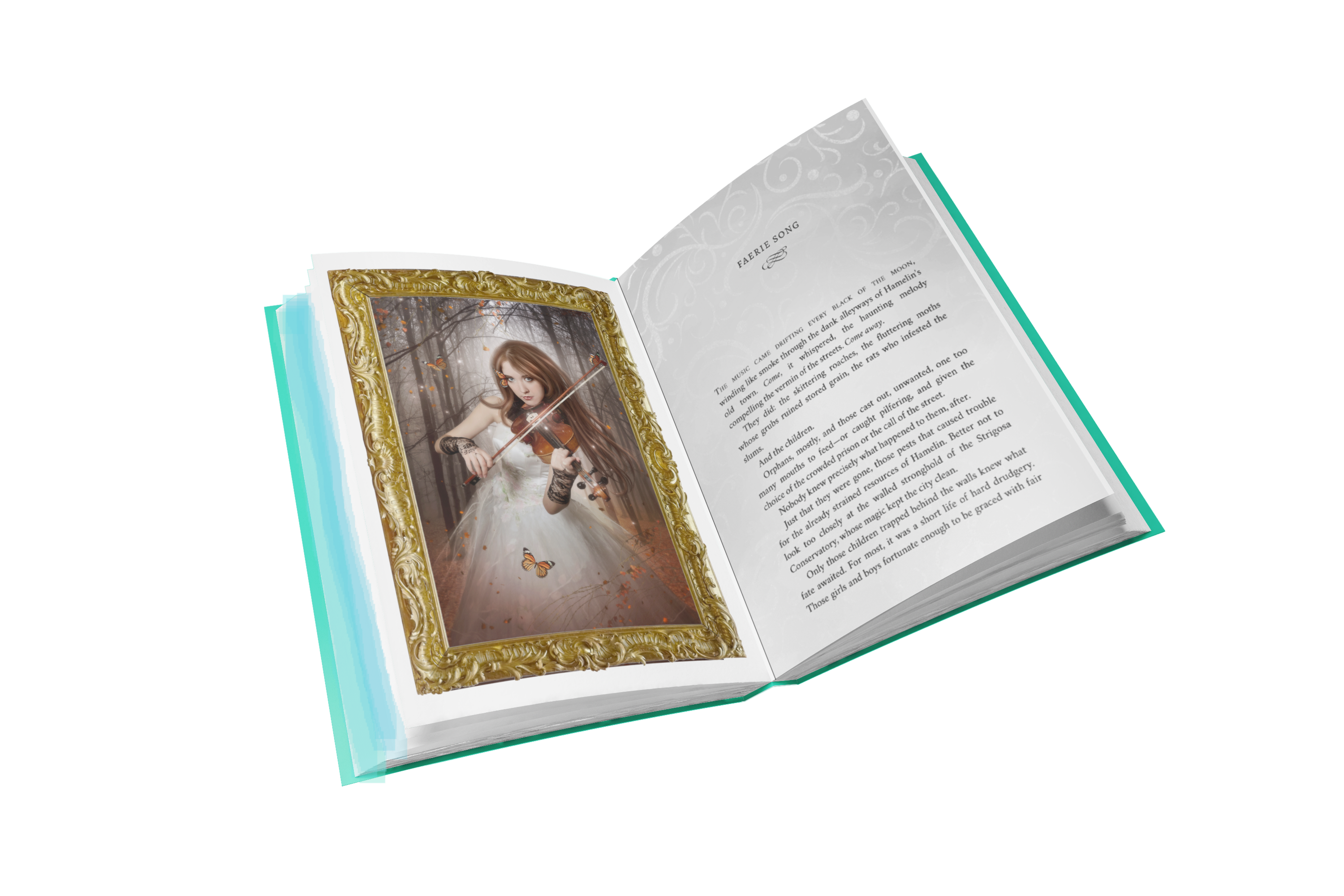
FAERIE SONG – A Dark Faerie Pied Piper Retelling
The music came drifting every black of the moon, winding like smoke through the dank alleyways of Hamelin’s old town. Come, it whispered, the haunting melody compelling the vermin of the streets. Come away.
They did: the skittering roaches, the fluttering moths whose grubs ruined stored grain, the rats who infested the slums.
And the children.
Orphans, mostly, and those cast out, unwanted, one too many mouths to feed—or caught pilfering, and given the choice of the crowded prison or the call of the street.
Nobody knew precisely what happened to them, after.
Just that they were gone, those pests that caused trouble for the already strained resources of Hamelin. Better not to look too closely at the walled stronghold of the Strigosa Conservatory, whose magic kept the city clean.
Only those children trapped behind the walls knew what fate awaited. For most, it was a short life of hard drudgery. Those girls and boys fortunate enough to be graced with fair faces were quietly sent to serve in the houses of the barons and magistrates of the city. The less-pretty children were set to work in the conservatory, either toiling without pay in the workshops or tending to the everyday needs of the Pipers and their students.
For students there were—lucky, or unlucky, depending on who was doing the asking.
Every child pulled through the imposing gates of the Strigosa Conservatory was tested for musical ability. Those that showed aptitude were assigned to one of the Pipers, those forbidding men and women that guarded the secret of the Calling. It was not an easy apprenticeship, no matter what the servant children thought. The Pipers meted out harsh discipline for any infraction. Whether a student misbehaved or simply missed a note, the punishment was the same.
Linnet Sheeran leaned forward from her vantage point atop the roof of the dining hall and winced as the coarse cloth of her robe scraped the welts on her back. That afternoon, she had botched the fingering on a difficult passage of notes, and suffered five lashings as a result.
The beating was supposed to keep her meek and obedient, and in the past it had done so.
But not tonight.
Maybe it was the restless energy of the Calling, or the hot autumn wind that bore the smell of smoke and despair.
The poorest quarter of Hamelin had burned two days ago, and the Pipers were expecting a handful of children at the gates. Barbed curiosity had brought Linnet to the small stair leading to the roof. Those students who knew of the twisty staircase half-concealed at the back of the upper linen closet guarded their secret closely. The roof was the only refuge they had. They never spoke of it, and if another orphan had claimed the roof, the protocol was to retreat until the first student left.
That night, the rooftop was deserted, and Linnet pressed herself into the shelter of one of the tall chimneys. The music of the Calling swirled coaxingly around her.
Stop, she told it. I am already here.
The woven strands of notes paid her no heed. She was thankful that it was easier to ignore that aching summons from inside the walls of the conservatory.
Pipes—clear and high—played the melody, supported by violins, lutes, and the heartbeat throb of skin-covered drums. It was a lullaby and lament, a promise and a lie, and despite herself, Linnet swayed to that beat.
She winced as her robe pulled across her abraded back again. Clenching her teeth, she willed herself to stillness and watched the wide courtyard. Cloisters enclosed the plaza on three sides. In those shadowed corridors, flickering lamps revealed the hooded figures of the musicians at their work.
They faced the fortified wall that blocked the conservatory from the rest of the world. There was no egress or entry except through the iron doors and barbed portcullis, which were kept tightly locked and guarded.
Except on nights of the Calling, when the Pipers’ magic ensured there could be no escape. Any creature venturing through those forbidding doors was going one direction only: straight into the clutches of the Strigosa Conservatory…
MISTRESS BOOTSI – A Puss in Boots Retelling
There are tales that begin Once upon a time, and I suppose that is a fine enough start for my own story, though I am not, perhaps, the usual sort of hero. I am not a knight or sorceress or princess in disguise, but merely a cat.
Very well, there is nothing mere about the feline state, I’ll grant you that. And yes, I imagine you might be surprised that I can speak. My great-grandmother was a Cait Sidhe who strayed into the mortal world and decided to remain, and her offspring have been part of the Miller family ever since—though I’m the last of them, it seems. My kittens, so far, are all of the normal, non-speaking variety of feline, with so little faerie blood as to make no difference. My own fault, I suppose, for choosing that strong, stupid Tom… but that is not this tale.
As a youngling, my mother warned our litter to be careful with our talents. Humans are strange, untrusting things, and she made us swear to only reveal our abilities in great need, and only to those whom we could trust beyond a doubt.
Many of my brothers and sisters, in fact, never spoke a word in their lives. But I did, and soon enough you’ll understand why.
When I was scarcely full grown, father and mother Miller decided to leave their lives as flour-grinders and retire to the warm southlands. After selling what they could, they divided their remaining possessions among their children. The oldest inherited the mill, which he was most pleased about, having the inclination to continue the family business. The middle daughter received the horses in the stables, and she was glad to add them as breeding stock to her own fine herd.
And the youngest daughter? Well, Elisetta had ever craved adventure, and I thought it a fine thing to be bequeathed into her care. Elly always knew precisely where to scratch behind my ears and under my chin, and she’d smuggled more than one dish of cream to me, when her parents weren’t looking.
One bright summer morning, the parents bid farewell to their offspring. My own mama groomed me one last time (though I was certainly too old for it) and told me to take good care of myself, cautioning me once more to be careful with my secrets.
I purred and butted her head with my own, and reminded her not to worry. My last sight of her and my older brother was the two of them curled up in the bed of the cart, content in the sunshine, as the Millers drove off.
Elly’s siblings had each offered to house her and give her work, but she declined. Instead, she prepared to take to the road herself, to see what adventures lay in store. I was happy to join her, especially as she’d devised a comfortable sling to carry me in.
In addition to myself, Elly carried a pack with some provisions and changes of clothing, and a pouch worn next to her skin with a few silver and copper coins.
As she was a strapping lass, and I a small cat and not too much of a burden, we made good progress. Soon we’d left the village behind and were striding briskly along toward the capital, where Elly hoped to make her fortune.
“I’m a good worker,” she told me, though she didn’t yet realize I could understand her, and reply if I chose. “I’m clever with my hands. I’d wager I can save up enough for a house of my own some day, if I find the right profession.”
I simply purred up at her and nudged her fingers, hoping she’d pet me under the chin again.
“I know I don’t want to grind flour, or tend horses, at any rate,” she said, absently petting me. “And maybe I should keep going. Take a ship and see the entire world!”
I gave a short, unhappy meow to that. The idea of being surrounded by water was not particularly appealing, even if it meant plenty of fish to eat. I was much more fond of staying dry than I was of a fresh piece of salmon.
Elly laughed. “Why, Bootsi, sometimes I almost think you can understand me. What a funny cat you are.”
I kept myself from making any reply, but merely settled down more comfortably in the sling, and soon fell asleep.
It took us several days to reach the city. Elly and I bedded down in a number of barns, where I was happy to catch mice (I’ve always been a most excellent hunter). Elly did a bit of work in return for supper, a place to sleep, and breakfast the next morning. The farmwives were generous with their provisions, and we never went hungry at lunch.
One afternoon we crested a hill, and Elly halted.
“There it is,” she said, her voice hushed with wonder. “The city.”
I peeked over the edge of the sling, then blinked to see so many buildings spread out over a green valley. Not all of them were simple one and two stories, either. There were towers and steeples, turrets and minarets jutting into the sky. The sea winked, flat and silver, beyond.
I was not altogether certain coming to the capital was a good idea.
But Elly, with a little skip to her step, started down the hill. I had no plans to abandon her, and so I was carried along with her into the noisy, smelly city.
Thanks for reading! Click below to return to BACKERKIT













 Anthea Sharp